More Dispatches from the road
Journal entries from Western China and thoughts on the future of TTFW

A note:
I have to start with an apology - its been quite some time since the last update from the factory window and plenty has changed in the months that have passed since I wrote about kids playing with cigarette cards. For one, I spent much more time on the bike, riding solo through Sichuan and Yunnan along the border of the Tibetan plateau. From there I made my way back to Taiwan where I rode the length of the west coast completing the 一日雙塔, yi ri shuang ta, one day two towers, crossing 520km in around 34 hours, no sleep and 11 flat tires. I made a few more trips outside of China too, visiting Japan for the first time, a conference in DC, a few trips back to London and Paris and most recently to New York where I’ll be based for the foreseeable future. I still work in research, mostly on China, but I have a feeling I’ll be back on the mainland soon enough.
I’ve been thinking hard about how I want to use this platform going forward. My hard drives are still full of photos and audio recordings, the still warm embers of stories waiting to be written. The notes app in my phone weighs heavy with furiously scribbled translations, blurred by baijiu but typically cogent enough to refresh the memory of a wedding toast, or a cab ride conversation or a lecture on Tang poetry in a soup shop. I have stories to tell about Henan, about drinking games and their particularities, about the time I spent naked in an all-male sauna, in a fourth tier city, interviewing a factory owner. I want to write about village farms and why they remind me of home, about the contradiction of Mao portraits superimposed over skyscrapers on the murals I’d find in rural villages. I want to write about the detour I took to a traditional Yi minority funeral in the mountains while on my way to a satellite launch site (no surprise I was refused entry). I want to write about the dying art of the travelling opera troupe and the few days I spent travelling with one. And of course, I want to write about my undying love for bicycles.
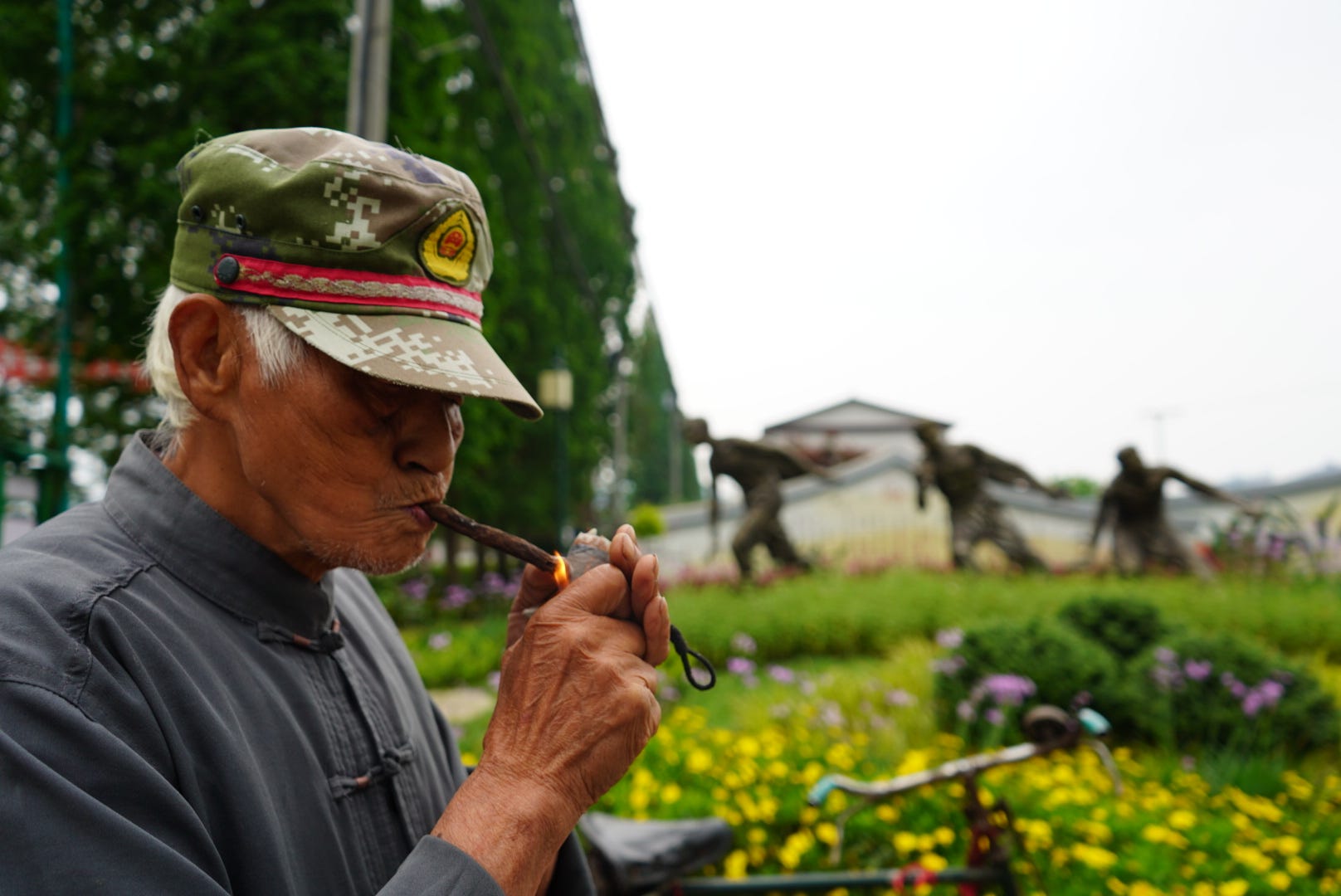
Fig 1. A former postman still riding the bicycle issued by his dan wei (work unit) in the 60s.
There are still so many stories I’d like to tell about the specific factory I called home and my friends that still work there. Hai Tang is dating a police officer she was introduced to through a family friend, Pan Zhun Wei is settling into a new life in a factory in the south while his son prepares for the gaokao this year, Chef Zhao still asks when I’ll next be able to visit the village (he’d like to prove to the other villagers that he still has a foreign friend). But I also want to spend time connecting their stories to the important changes happening in China today, of course with respect to manufacturing, but also on demographics, working culture, social change, urbanisation and the environment. I think their stories are representative of many of these broader challenges and are told in a voice that we hear far too rarely.
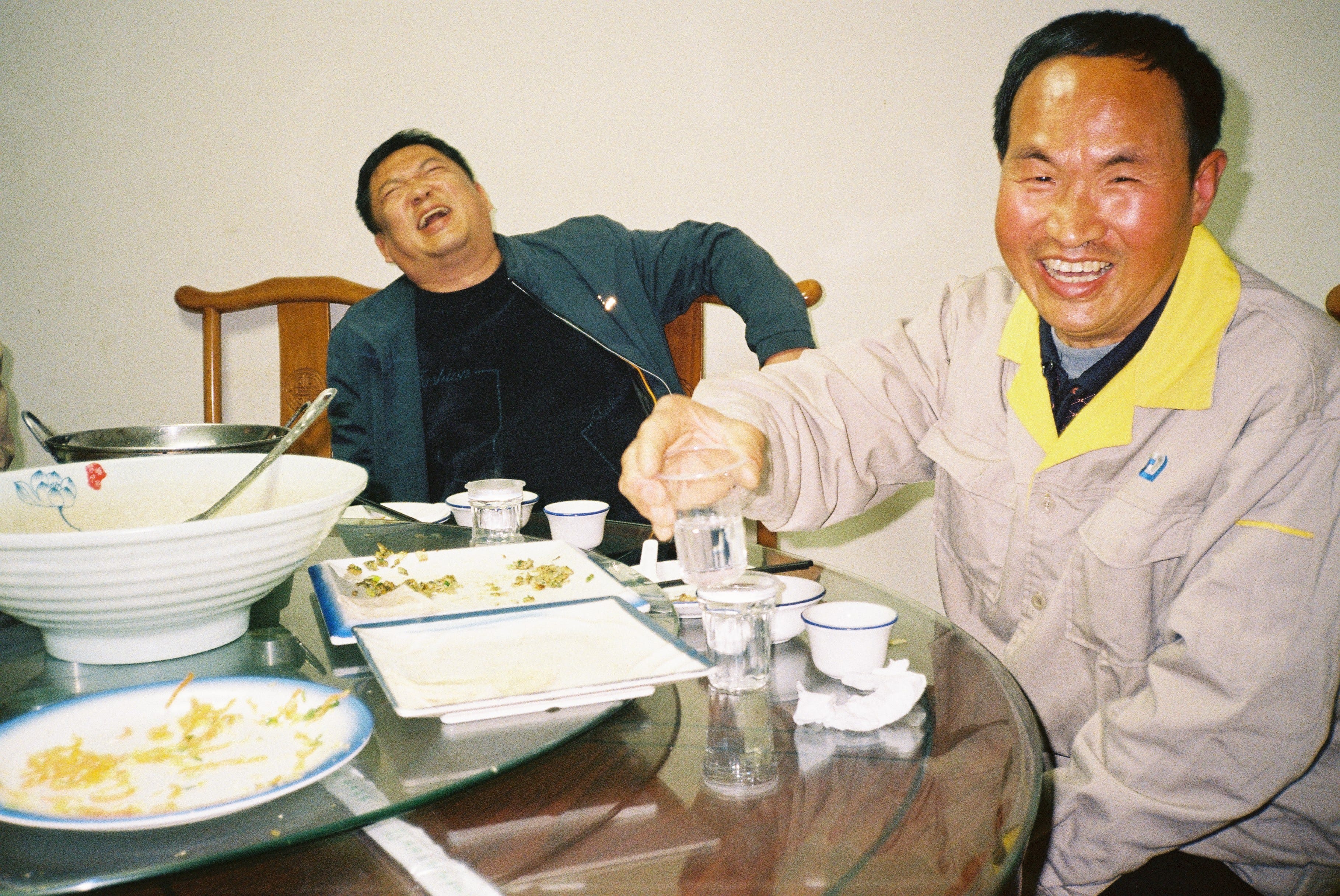
Fig 2. Baijiu toasts at a little restaurant near the factory
I was catching up with Peter Hessler, another China writer, at the launch for his new book “Other Rivers, A Chinese Education”, a few weeks ago. His wife Leslie Chang’s book, Factory Girls, was a source of inspiration during my masters degree and for the work of the last year and remains some of the best writing on China's factories. We caught up on the work I’d been doing in China, he was an early advisor on the TTFW project and a reliable source of encouragement since, but we spoke mostly about the increasing difficulty of doing research in China. We discussed a fear we both share that too few young people are doing this kind of work, with the decline of cultural exchange programs, and how the difficulty of writing from China is re-shaping the stories that we hear, particularly from the rural interior.
My new “window” has me spending a lot of time thinking about the broader system risk evolving in our politics. This moment feels like the closest we’ve come to threatening a true de-coupling from China with the escalation in trade-tension threatening forms of horizontal escalation and rising uncertainty that will continue to destabilise relationships between China and the rest of the world.
One thing that has given me pause though from the picture of doom-and-gloom has been the richness of this platform, and the incredible writers, researchers, and explorers that it continues to connect me to. Substack feels like what I want most from a social media platform, fewer influencers teaching me recipes I’ll never cook, and more people writing for others, sharing photos, and reading their stories aloud. I’m obsessed with Vivienne Wei’s, Chinese Farm Chronicles, she takes stunning photos and ends up in the most insane locations. We actually met through this substack and spent a week together last year camping in the rain on the outskirts of Changsha. I’m a big fan of the work of Far & Near too which always shares beautiful visual storytelling from China.
Finding these Substacks encourages me that there are still those telling human stories often in emotional and humorous ways, and a reminder of how grateful I am for this community. There are now over 350 of you that subscribe to this newsletter including so many writers that I deeply admire and for that I continue to be grateful.
The story I'd like to tell here is more of a collection of stories, something that I've done before in this newsletter (read the original Dispatches from the road here), but is broadly a collection of anecdotes from riding my bicycle this time in Western China. These are reflections that spark something for me, and maybe something for you too.
It’s hard to tell which side of the window I’m on now. Its hard to say that my life in an apartment in the East Village in Manhattan bears any resemblance to what my life in Henan once was. I just know that stories left unwritten, slip through fingers like grains of sand and I want to do my best to cling to every one of them. This Substack feels like the best place to hold on to from with a community to keep me accountable.
With love,
As always,
Kenza
12th May 2024
The climb feels endless. You wonder how a hill can be built to only have one side. You have to get off and push, head light, floating towards the clouds while your body remains tethered to the ground. You haven’t eaten and you can feel it. You start thinking about the wanderings of Ma Jian, the Chinese travel writer, and his collapse chasing a mirage across the desert in the Chaidam Basin.
"When I left Beijing I thought to myself, it doesn't matter where I go because I can dig my grave anywhere in China's yellow soil. But now that my life hangs on a thread, my only thought is of survival. I force my eyes open and try to see what lies ahead." - Red Dust, Ma Jian
You decide your situation isn’t quite as desperate and push on.
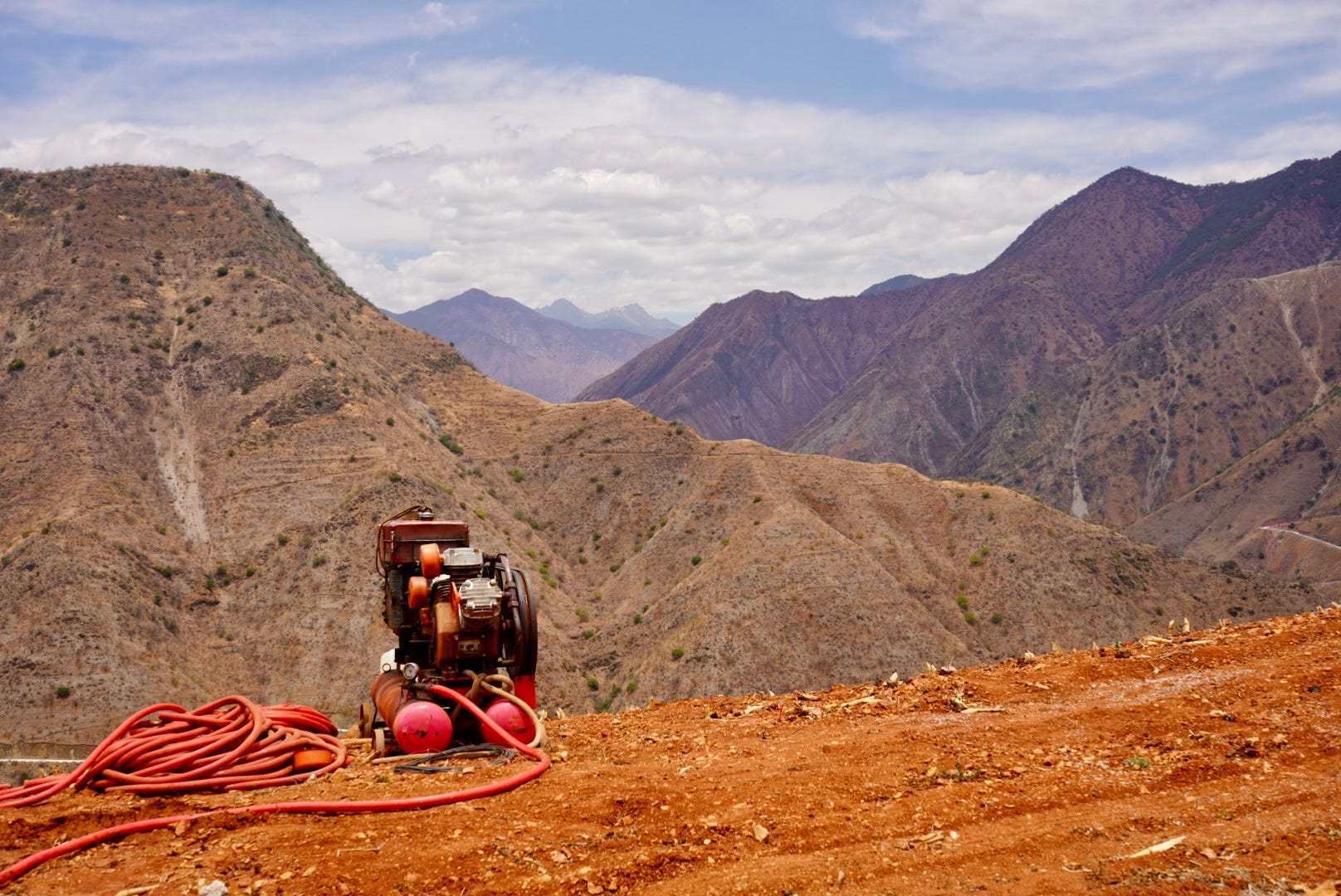
Fig 3. Endless switchbacks crossing trucking roads on the Sichuan-Yunnan border
You watch as four goats make their way up the road ahead. They stop and graze, they’re watching you, and before you get too close they pick up into a trot again. They don’t get too far before they stop again, they look back. You start to wonder if they are waiting for you. This goes on for nearly an hour. The only sounds are chirping birds, a gurgling stream, the shortness of your breath, the heat of the asphalt. Not a single car passes. The goats lead you to a bend in the river and stop outside an ornate gate on an empty mountain road. It looks out of place, of a different time, a grand gesture in a silent landscape. The goats disappear through the gate, you hesitate, then follow them through.
Suddenly there are sixty goats of various sizes, covering the ground like misshapen stones, baking in the sun. It takes you a moment to spot their herder, a leathered man leaning against a tractor at the end of the lane. “Can I bother you for a moment” you ask, while stepping between and over goats. You tell him you’ve been riding in the mountains and ask if you can rest. He nods and leads you wordlessly into the courtyard. You cross a small bridge that spans the narrow stream. You shut a small gate behind you and return the gaze of a hundred curious, beady eyes.
The three buildings in the courtyard reflect the passage of time, the first of dark aged wood, cracks worn defiantly. The second boasts timber still light with youth, forest scenes delicately carved into doorway panels. The final building is whitewashed concrete dotted with red window frames, a reminder of the modern convenience overcoming craftsmanship, an echo of the contrast you’ve seen between old tradition and new comforts in most of the villages you’ve passed. A long wall encloses the final side of the courtyard, a moon gate, a steeped temple roof, metal doors with large brass handles, three rudimentary beehives. The buzzing of the bees mixes in the air with the ripples of a stream and a light rustle of trees in the mid-afternoon breeze. There are cows somewhere nearby, you can’t see them but you can hear their bells.
He tells you to go pick berries and you oblige plucking the bright red orbs from the tree in the middle of the courtyard. You pop them in your mouth four at a time, spitting out the seeds into your palm. You return to the porch and he wanders off to the goats. You can hear him shouting instructions in a dialect you don’t understand. His wife wanders the farm but never acknowledges the stranger on her porch. You watch her for a while, long hair braided down her back, as she scatters feed to the chickens that dart around the yard. A few manage their way into an outhouse and she scuttles them back out.
You fall into a sleep on the porch. You dream of a vast lake in the early morning, the features of the water and the surrounding mountains slowly coming into focus. As you climb you watch as the morning sun peaks over the mountain. You’re willing it to rise, hurry, pleading that it will rise faster and warm your freezing body. You’re crying now as you beg and yet the sun rises as slowly as it does every day. As you reach the top you find a ray through the trees and stop to face directly into the light. You soak the warmth slowly into your fingers first, the salt of tears and sweat mingling on your cheek.
You wake up in the courtyard disorientated. You look to the sky and see the sun beginning to fall, dipping behind the mountain. “There it goes again,” you say to yourself with a laugh. You realise it wasn’t a dream but a memory of the lake this morning. At dawn your fingers froze, in the day you suffered under the heat of the full sun and yet now, as the sun retreats, you sit in near total peace. You begin to collect your things and find the farmer still sitting with his goats. They speak in whispers now, deep in consultation and yet you still don’t know what about. He never asks where you’ve come from, why you speak the same language, where you’re going. He just nods goodbye as you leave, through the gates and into the world.
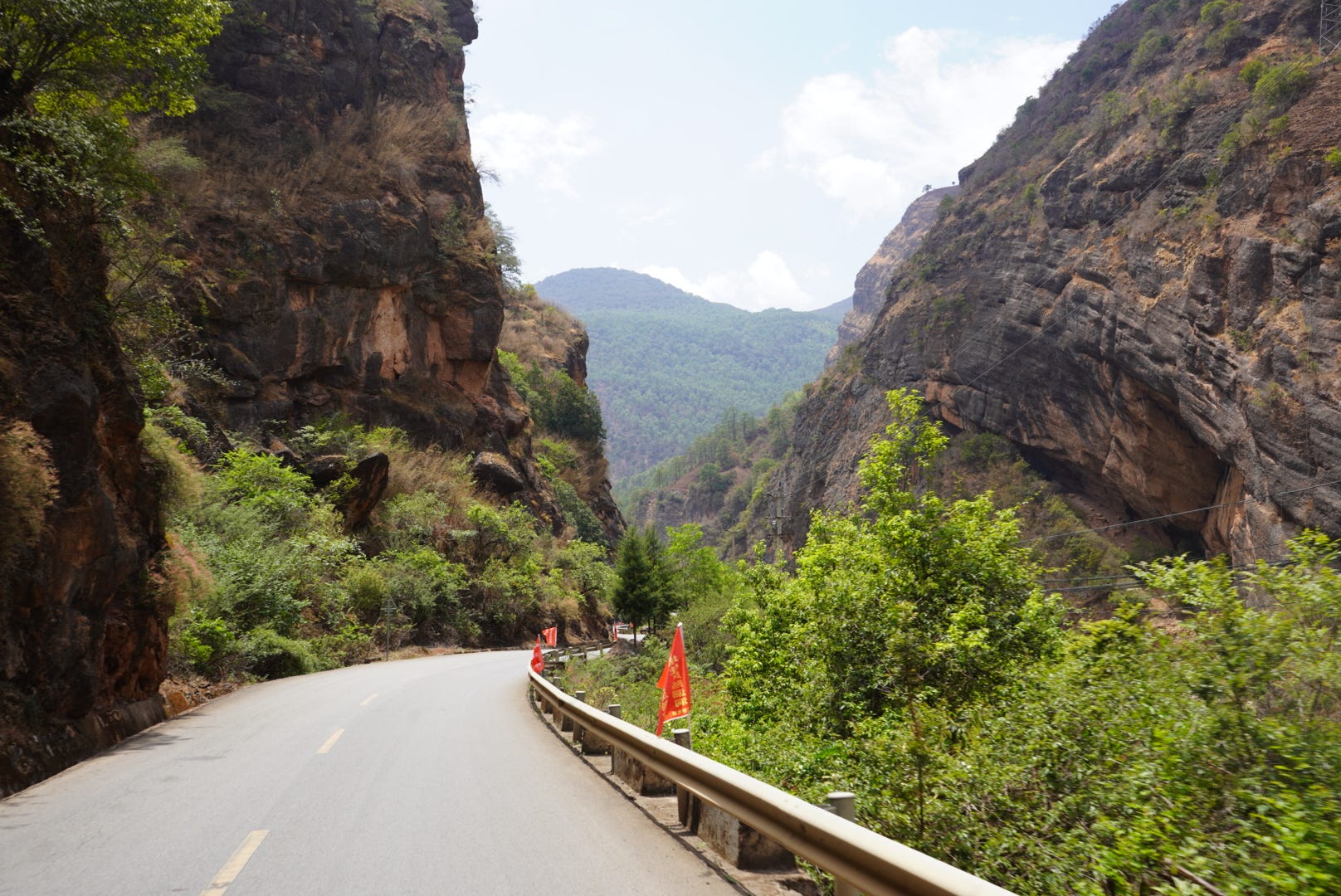
Fig 4. Descent into a valley outside of Xichang in Sichuan province
10th May 2024
Detour for a funeral
In a landscape as vast as China's western reaches, I often found myself asking, what makes for a meaningful detour? What is an attraction worth departing from the road? How far would I ride from the path to find it? Are tourist attractions really what I want? Why am I out here at all?
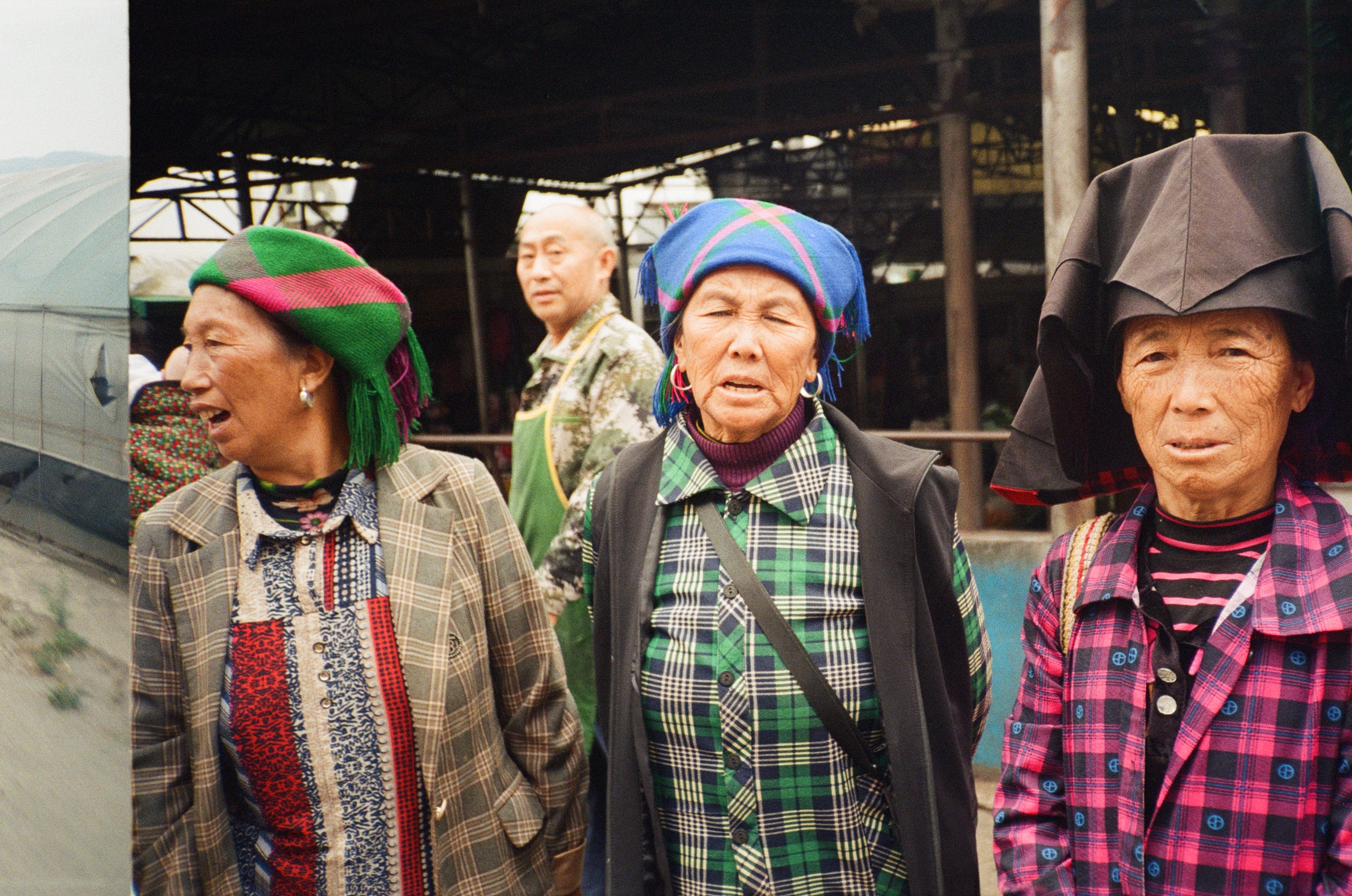
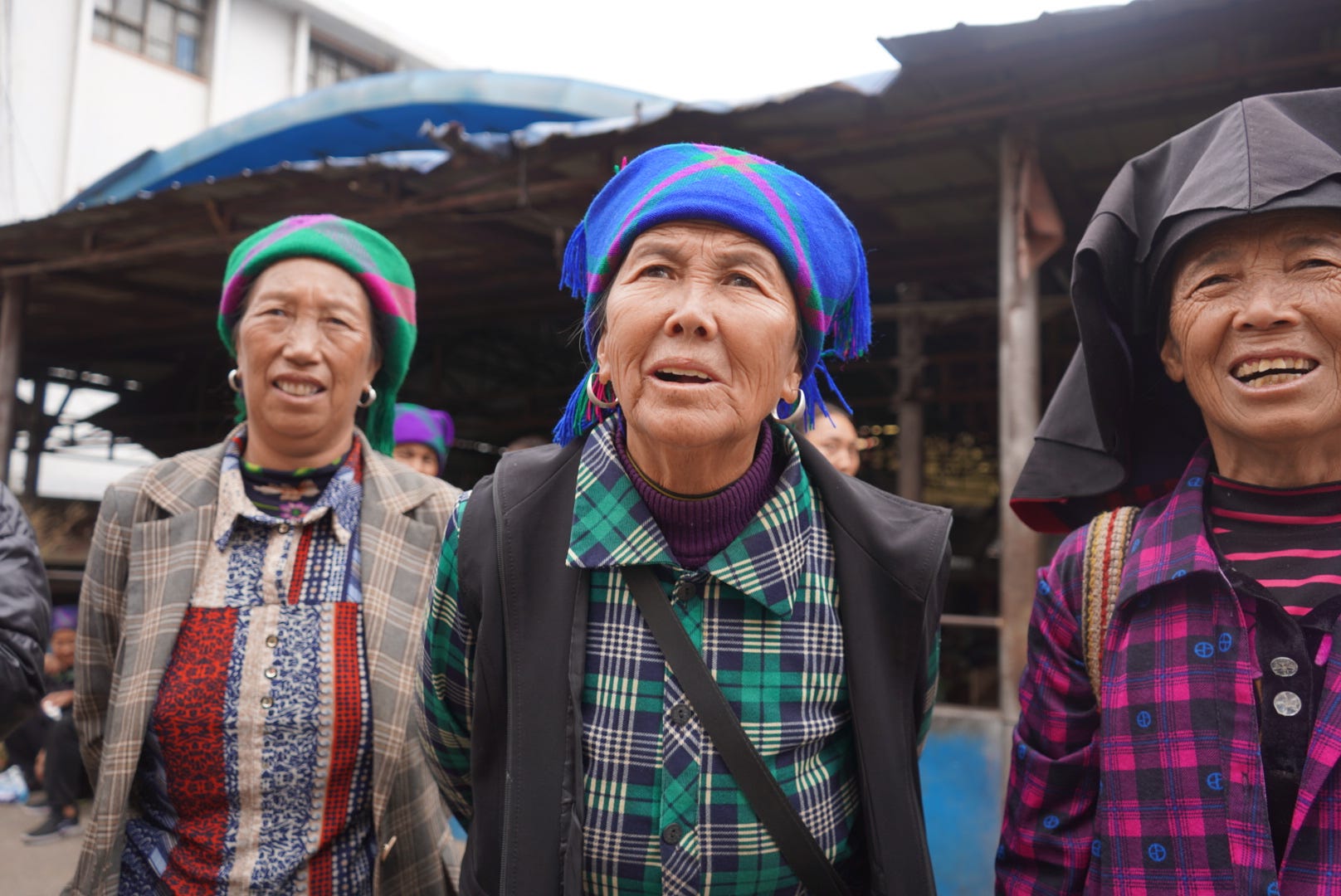
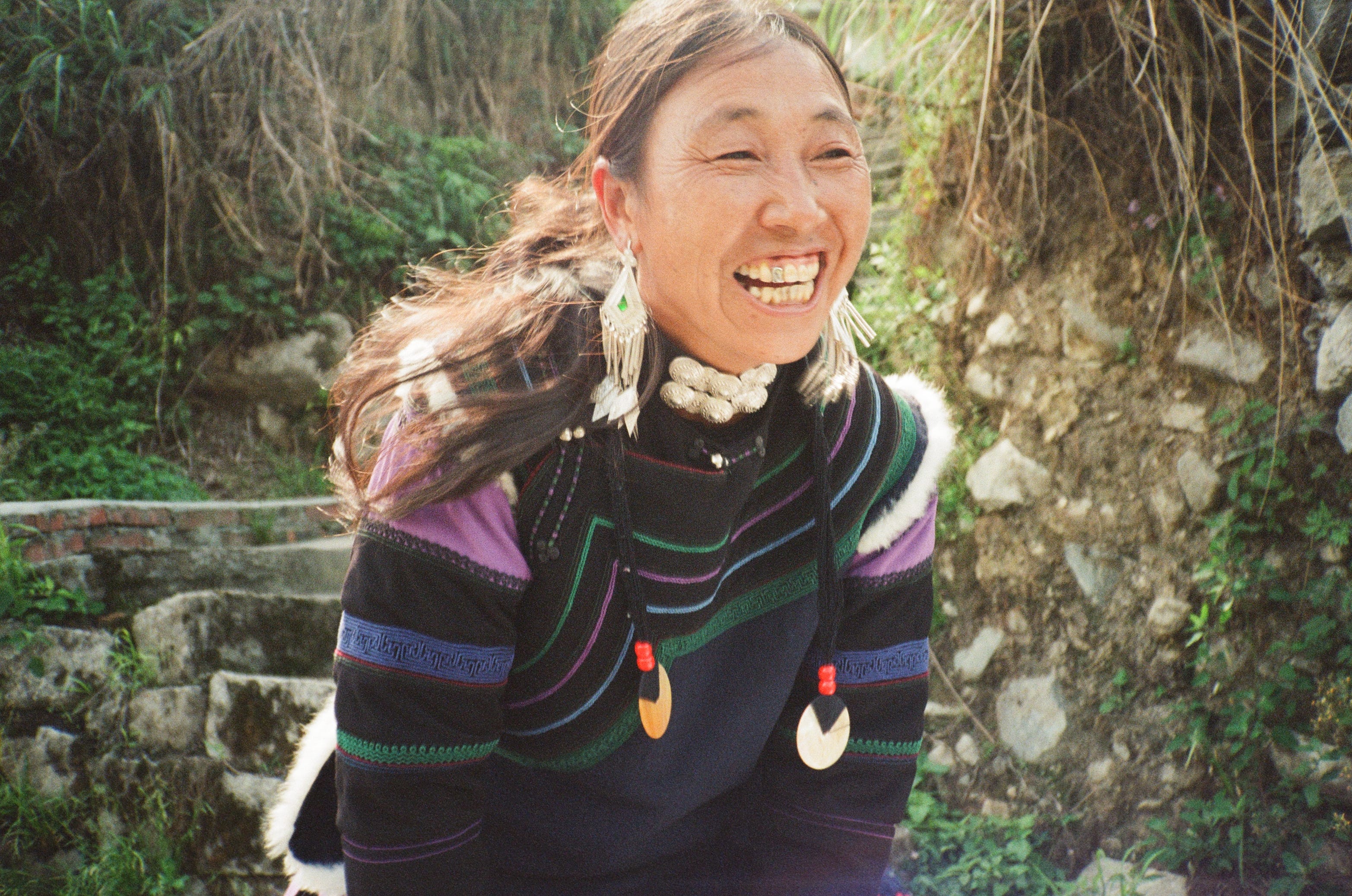
Fig 5. Yi women outside of a village market
The ride started with an obsession with landmarks, a lonely planet of places that guides tell you not to miss. The route I planned stretched 1,200 km over 20,000m of elevation crossing luscious mountain landscapes, coursing river gorges, panda reserves, villages in the Tibetan border-region. I left Chengdu and took the route through Leshan to see the world’s largest stone buddha, carved into the mountain face. From there I turned west to ride towards the shores of Lugu lake, the “mother lake” of the Mosuo peoples to reach Gemu Goddess mountain. But the real detour began when I decided on trying to ride into one of China’s handful of satellite launch sites, built into the hills outside of Xichang. My arrival was met, truly, with incredulity and shaking heads. “Silly foreigner” they thought as I pedalled away.
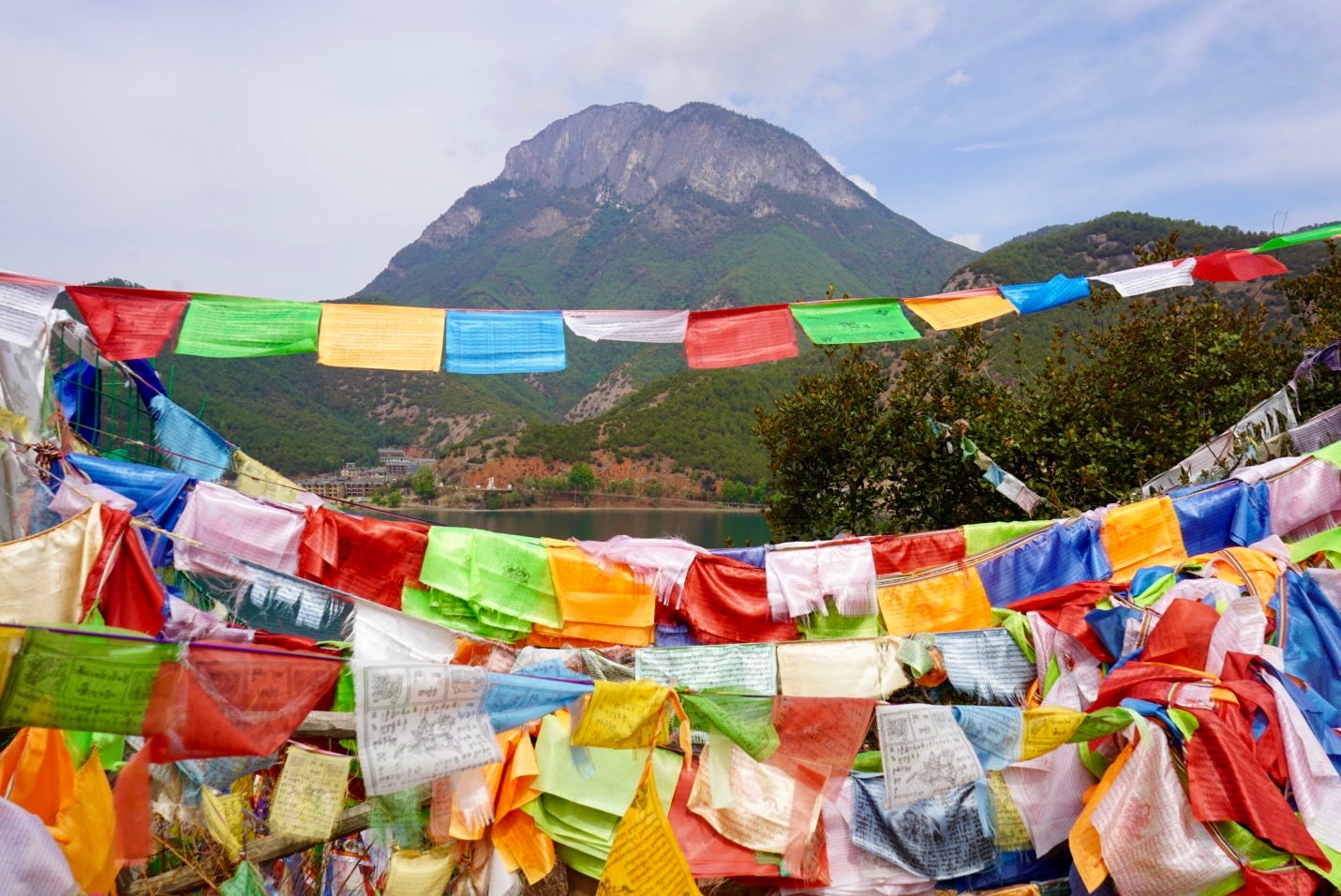
Fig 6. Photo taken from the shores of Lugu Lake looking back towards Gemu Goddess Mountain.
It was on this road and the slow ride back out the valley that a boy came to drive alongside me on a sputtering motorbike, exhaust kicking, as he fiddled with the clutch to match my slow speed. He asks the usual questions, Where are you from? Where are you going? Why do you speak Chinese? And I do my best to respond between heaving breaths in the thin mountain air. London, Dali, I don’t know your guess is as good as mine. He asks if I’d come and see his home and though initially hesitant about yet another detour from the detour, I eventually accepted.
The boy was only 19 as it turns out, working as a firefighter in Shaanxi province on the other side of the country. He had made the journey back to his village after hearing the news that his father’s condition had worsened, and as we climbed towards his home he told me he had passed the previous night. I couldn't quite remember what the right thing was to say in Chinese, only that to say “I'm sorry” as you might in English would be to admit culpability for the death of his Dad, something I was keen to avoid. I eventually chose 别太难过 bie tai nan guo something like “don’t be too sad”, which felt deeply inappropriate to me and yet soothing somehow to him. The family lived in a nest-like collection of houses, an ant-hill built haphazardly into the hillside. Like the farmer, each building clearly came from a different era, expanded upon as time passed, the compound wall knocked down and re-erected with each expansion. They had expanded as far as the train tracks permitted, now so far that the tracks ran directly though the driveway. We arrived to a collection of men, scattered much like the goats, but this time on red plastic stools surrounding round tables, others perched in squats on the train tracks like birds strung on a telephone wire. When I introduced myself, feeling underdressed in cycling lycra as per usual, I had to speak up to be heard over the desperate squealing of a pig. The noise growing into a violent crescendo before the small stream that runs down from the house and past our feet darkened in colour until it ran deep red.
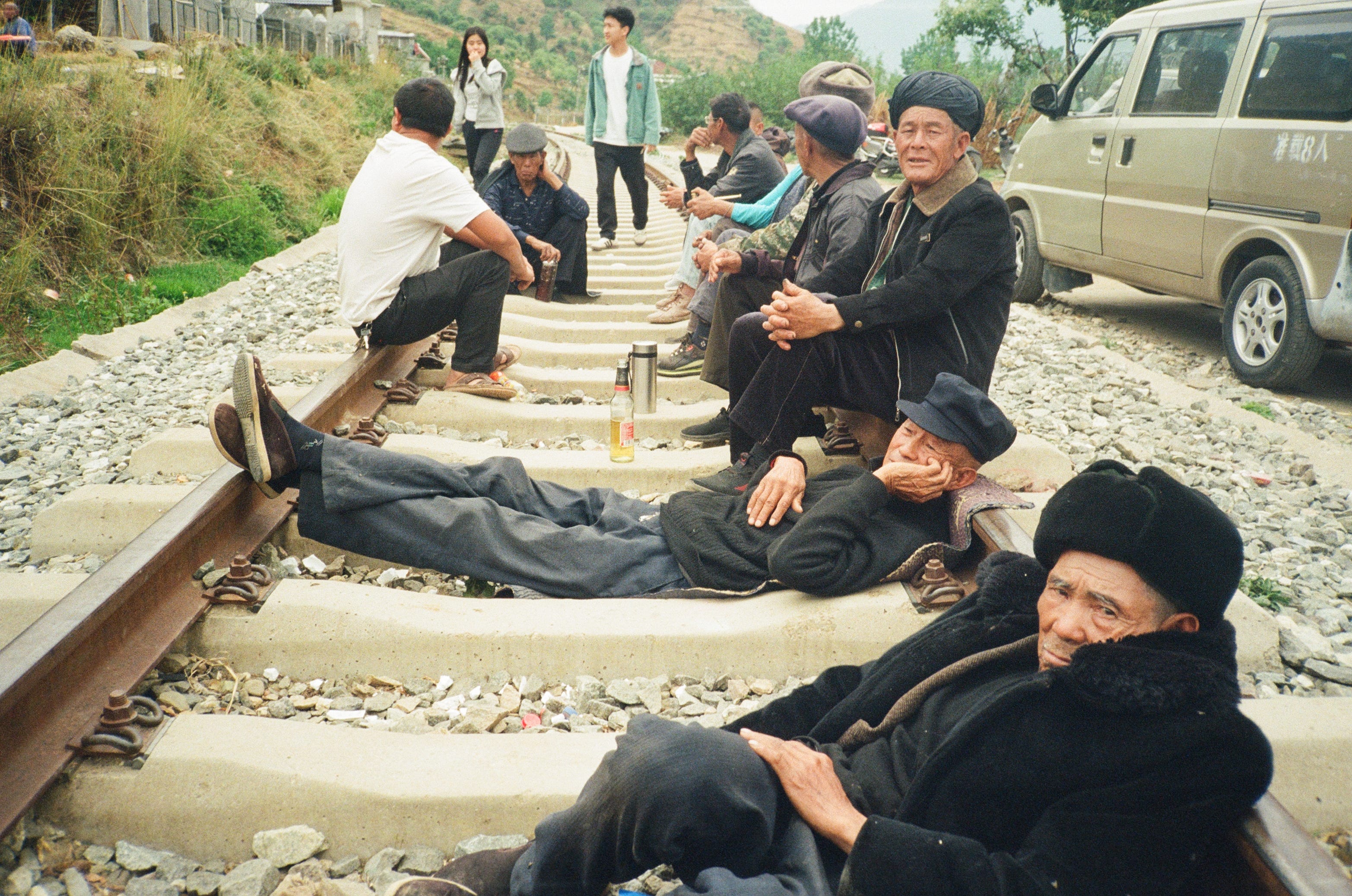
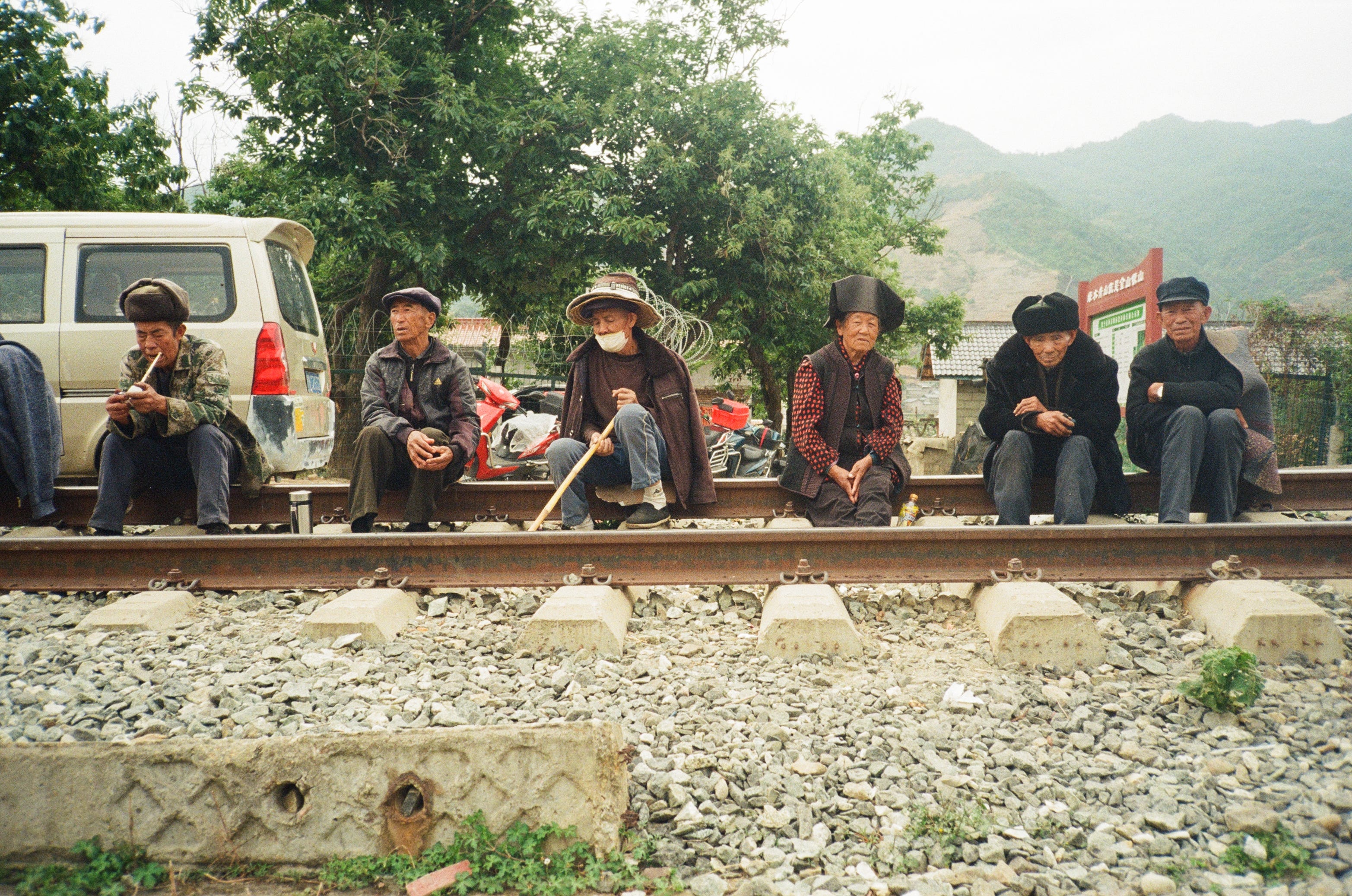
Fig 7. Train track perch outside of the funeral.
The mouso people are a matriarchal society and its reflected in the burial rights. Eventually I was led away from the men outside, into the house where his father lay in state. There were only women inside the room, dressed in traditional garments, wearing enormous striking hats two feet tall and across. His body sits on a platform, swaddled in blankets. The room is bare, untreated concrete on every surface. Oddly enough, one wall is adorned with a bright pink blanket over which hangs a portrait of the deceased. Light enters the room from a single window and the women, with their tall hats, sit leaning against the walls. The room is full of gifts, stacked in a pyre that surrounds the body. The gifts are the kind that come wrapped in boxes that I’ve only around the holidays. Boxed teas, preserved milk, dried fruits, a daisy chain of boiled sweets hangs from the ceiling. The room is silent save for the tears of a single woman crying directly over the body. As she cries, another woman hums softly, melodically, while slowly fanning the body with a large frond from a tree. We step back outside for a toast, “Zumu guni” I say as we drink, one of the few phrases I learnt in the local dialect while playing pickup basketball with Tibetan police officers a few days before. I pour a splash of liquor into the earth before draining the remainder of the glass. We pass by his mother and he introduces me as the foreigner that he’s found on the road and I do my best to offer my condolences with only my eyes. Her eyes seem to accept them but I also sense a light irritation that her son has brought this foreign stranger to her husbands funeral. I take this as my cue to get back on the road. As I leave, an uncle unleashes a salvo of pyrotechnics from a makeshift mortar in the driveway he controls with a little radio remote.
Somehow, it transports me back to my grandfathers funeral in the hills of Clarendon parish, rural Jamaica. Grandpa Timmy used to haul sugarcane in large trucks over narrow country roads, collecting on behalf of small hold farmers, transporting the raw cane to the rum distilleries a parish over. At his funeral, as we lowered his casket into the family plot at my grandparents home, his friends played a trucker’s gun salute blasting the horns of sixteen wheelers while a marching band stomped in full regalia.
Old men still perched on the train tracks waved goodbye.
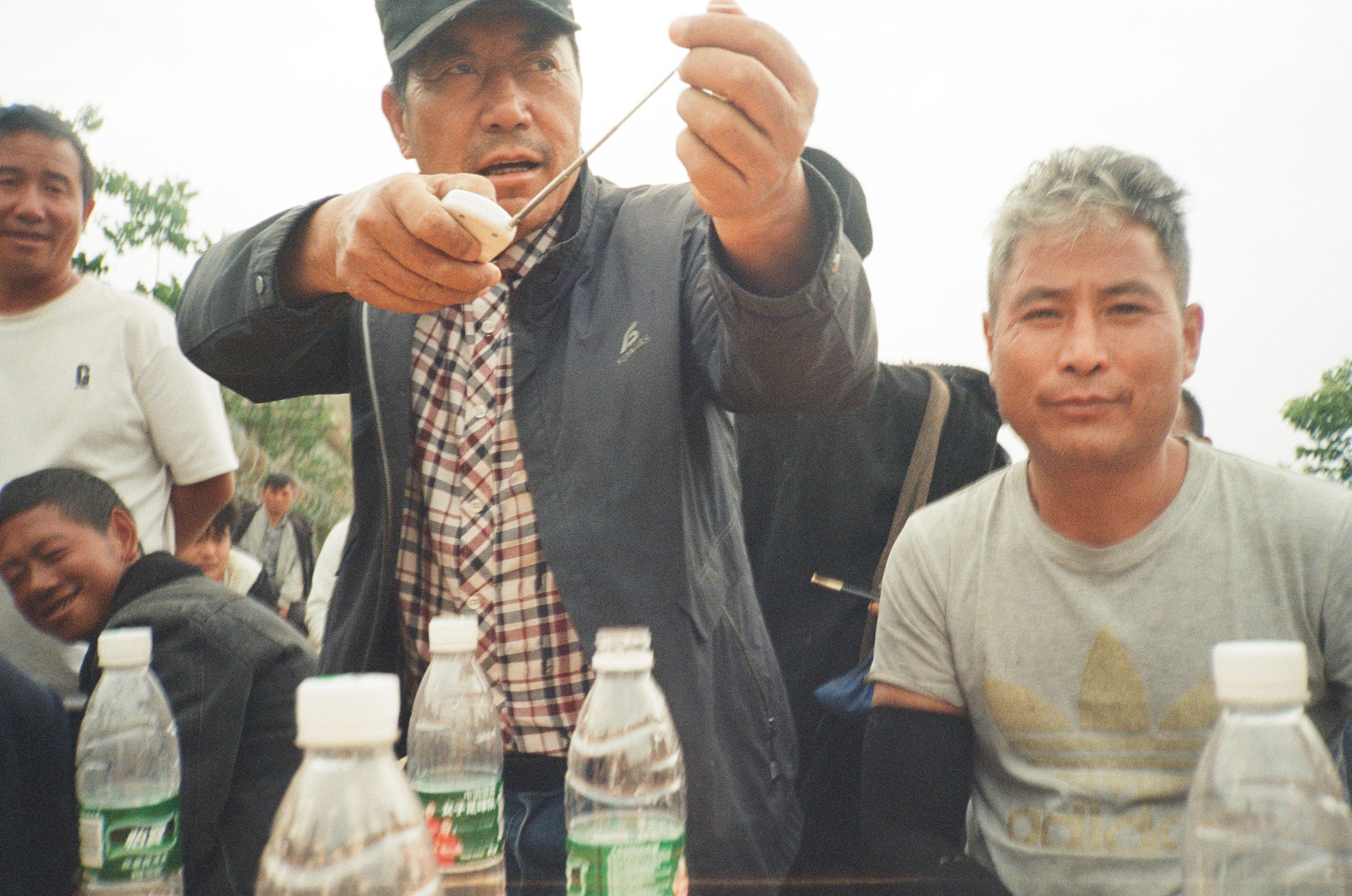
Fig 8. Man operating the remote control mortar at the end of the driveway
I think we’re all constantly taking detours, on land and in our minds, they just might not be to the places we thought they were to.
May 16th 2024
Asking locals for directions
There is a story I think of every so often of the ancient Chinese explorer Gan Ying. As legend has it, recorded in the Hou Hanshu, a document compiled by Fan Ye during the Song Dynasty, documenting the history of the Later Han Dynasty, Gan Ying was a military official sent on a mission by General Ban Chao to make first contact with the Roman Empire. The Chinese were at this point aware of the Romans, through whispers passed ear-to-ear by traders along the Silk Road but had yet to make direct contact.
General Ban Chao’s forces had recently come to control oases in the Taklamakan desert, modern day Xinjiang, having invaded the Tarim kingdoms south of Ferghana and in doing so reached the north-eastern border of the Parthian Empire. Seeking to break the monopoly held by the Parthian Empire over the silk-road Gan Ying travelled covertly through Parthian territory until he reached the Persian Gulf. Now, he could have spent 40 days tracking north along the Eurphrates until he reached the Roman border in Syria and the city of Characene. But the Chinese, believing that Rome was to the northwest of the Indian Ocean planned instead to sail around Arabia until they reached Roman Egypt.
It was here that Gan Ying asked local seafarers for directions. The account they gave were of treacherous seas, waves two mast high, a journey that takes three months in favourable winds, two years if the winds delay you. They suggest bringing supplies for at least three. In the Hou Hanshu Fan Ye writes, “The vast ocean urges men to think of their country, and get homesick, and some of them die." When [Gan] Ying heard this, he discontinued (his trip).”
Hearing the words of the local fisherman, he turned around and never reached Rome.
At some stage in the journey I accepted that asking villagers for directions could be treated only as a form of entertainment rather than a strategy of navigation. To ask the question, “How long will it take to ride over this hill?” requires both parties to be in agreement over what constitutes a hill and how fast one could reasonably ride their bicycle up and over it. “How much longer before the downhill starts?” only provides a useful answer if in fact the villager in question has ventured beyond the confines of their valley.
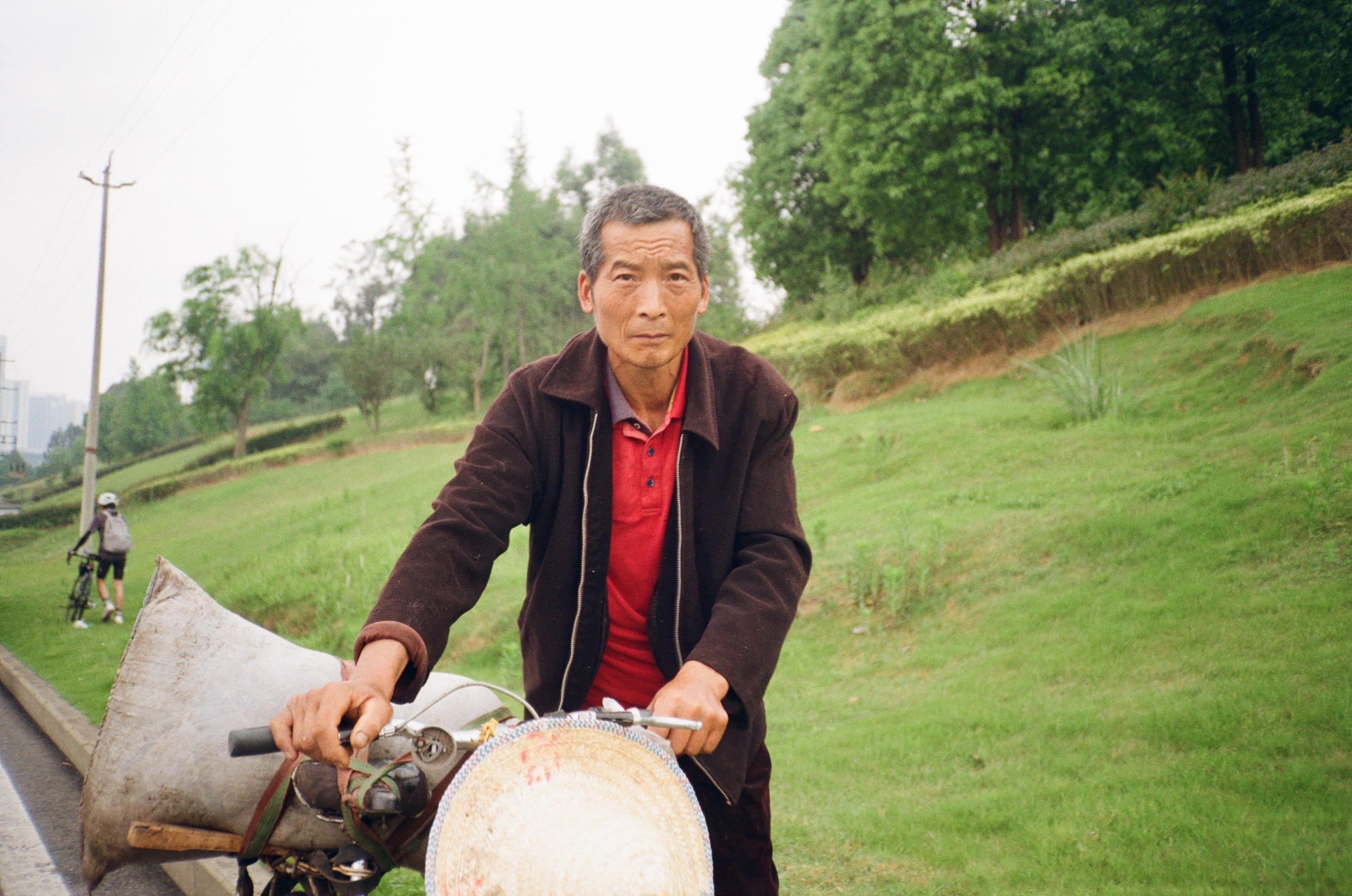
Fig 8. A man pushing his bicycle through gridlock traffic on the highway out of Chengdu towards Leshan on the first day of the May Labor Day holiday.
I’d stopped in a mountain pass, trees shrouded in the thickest fog settling through the pines, obscuring small shrines to mountain gods littered in the underbrush. I reach an impasse, a fork in the road. I check my phone. No service. A light rain begins. I stop to ask for directions from a group of farmers. Four couldn’t read the map, two couldn’t speak Chinese, the final man bravely took a look, flipped my phone around a couple times, before offering a shrug. I figured that someone with a car must know how to make it back to a main road. I found a kind family with a white Changan SUV parked outside. They lived in the city but had returned for the holiday and so we shared lunch before they pointed me in the right direction.
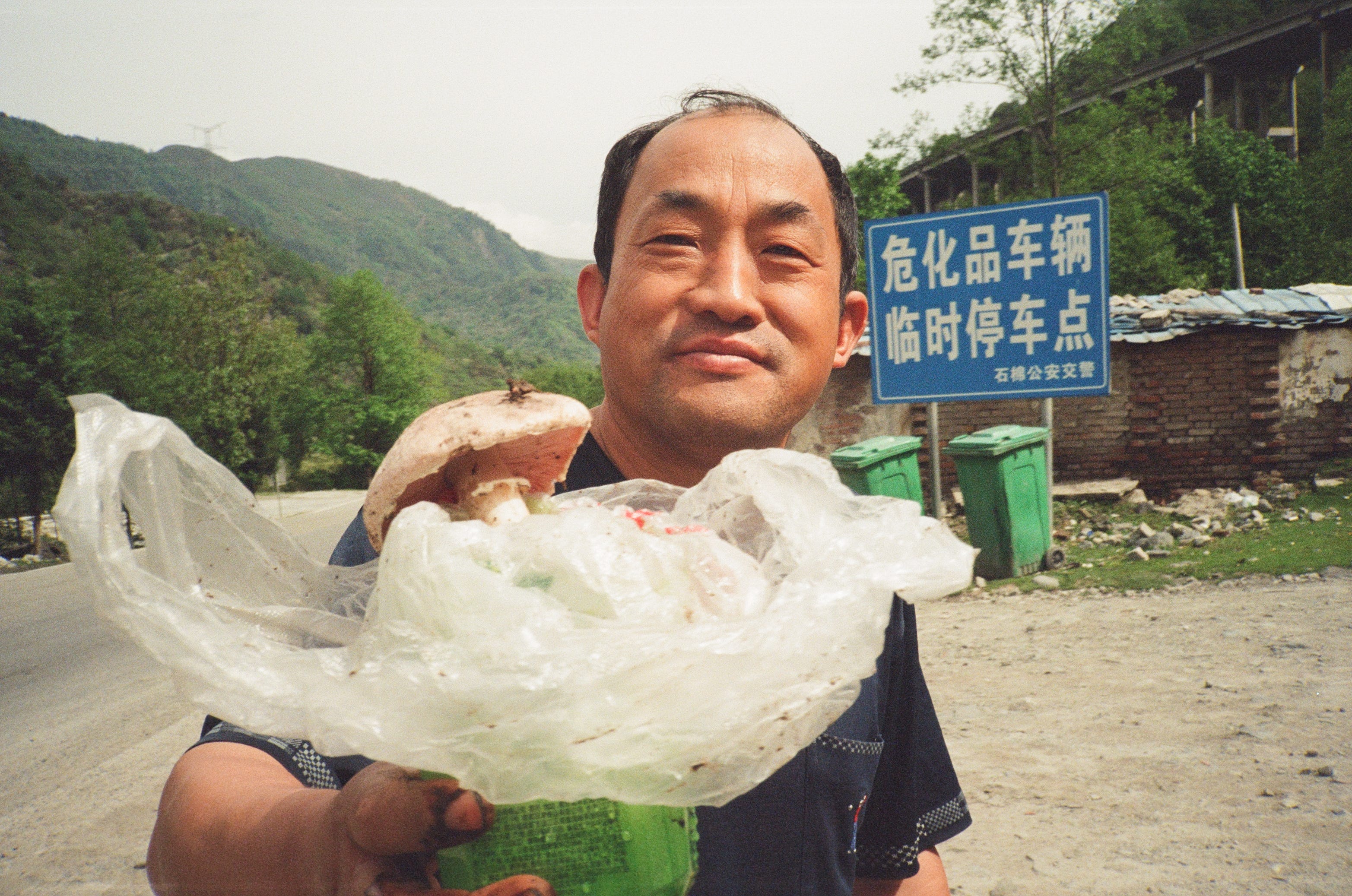
Fig 9. Trucker showing off the prized mushroom he’d been growing on in his truck.
I next stopped to ask a group of truckers how far it would be to the next city. We didn’t end up talking about where to go but rather about life on the road. We sat on the floor in the short shadow of the truck hiding from the sun and spitting the husks of sunflower seeds into the dirt. We laughed about all being from Henan. One of the men proudly showed me a mushroom he had been growing on the dashboard. Others filled my backpack with a fresh supply of oranges when I wasn’t looking. I asked about the distance because I was worried about my chances of reaching the city before dark. They asked why I hadn’t thought to bring a tent. Very helpful.
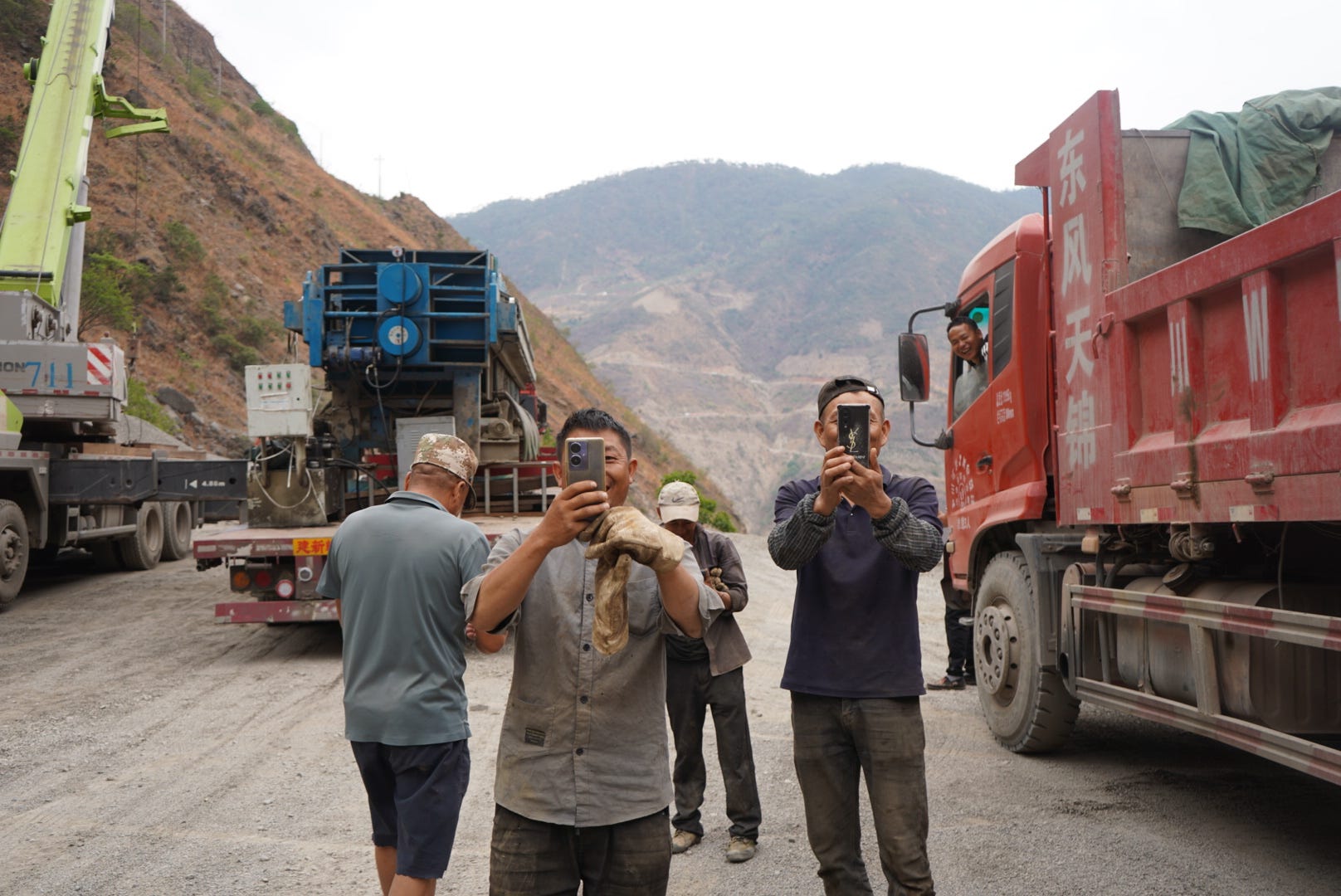
Fig 10. Henanese construction workers reinforcing the hillside surrounding a tunnel in Sichuan.
I’d been riding since sunrise. Having crossed into Yunnan the complexion of the roads had shifted drastically and now they were the kind of switchbacks found on mountain passes where you look 500m directly up the hillside and identify a point thats 5km up the road. Nearing the base of Jade Dragon Snow Mountain, and at the end of my patience with a day of riding, I flagged down two men driving a little truck with a flatbed off the back. I pictured throwing my bicycle in for a lift down the road. They told me earnestly that of course they could give me a lift into town, but then again, why give up now when the downhill starts only two kilometres from here. They insisted I’d get there within half an hour. Two hours later I found myself still cursing in the dark, flashlight flickering, pushing my bike towards a still distant ridge line.
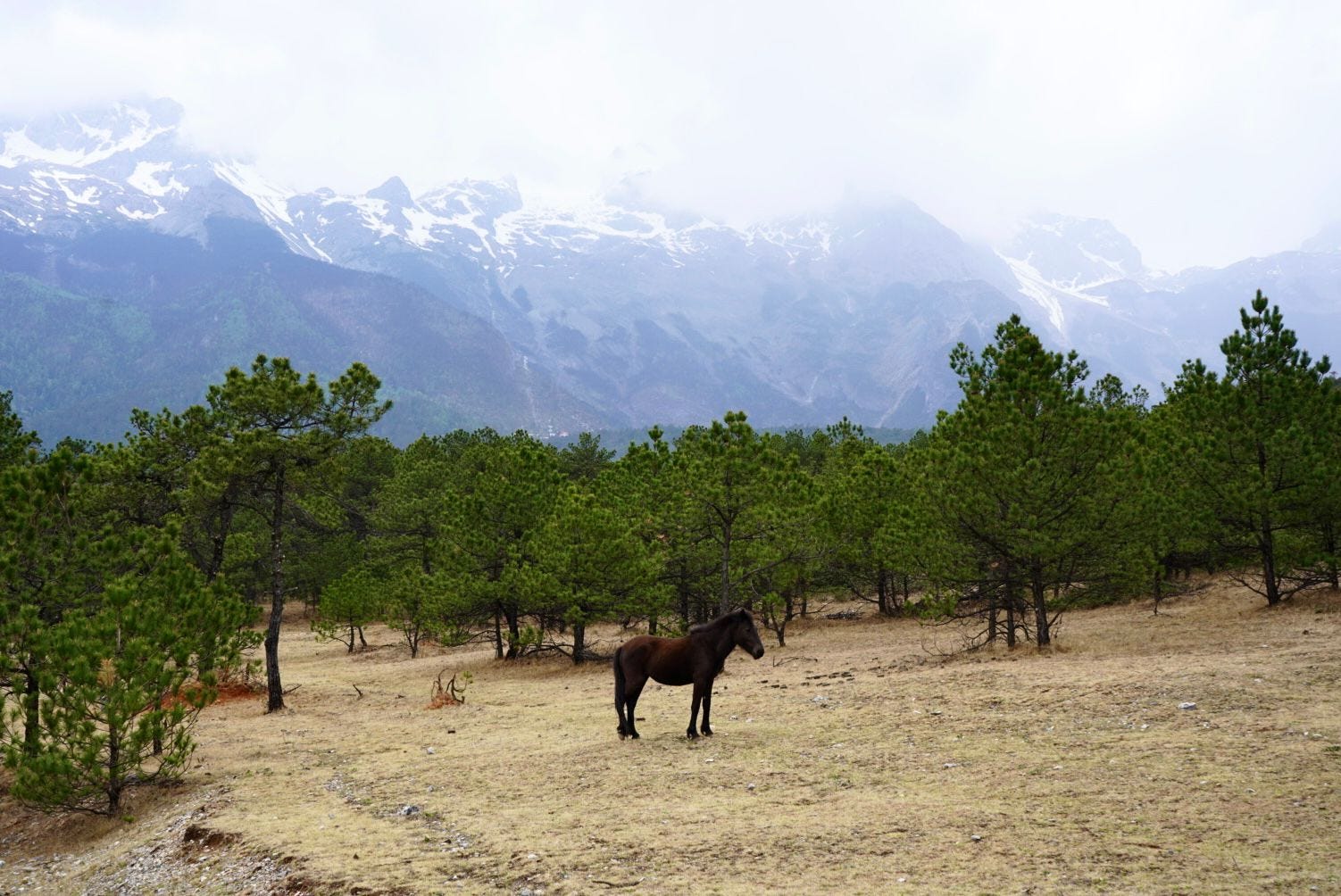
Fig 11. Photo from the base of Jade Dragon Snow Mountain
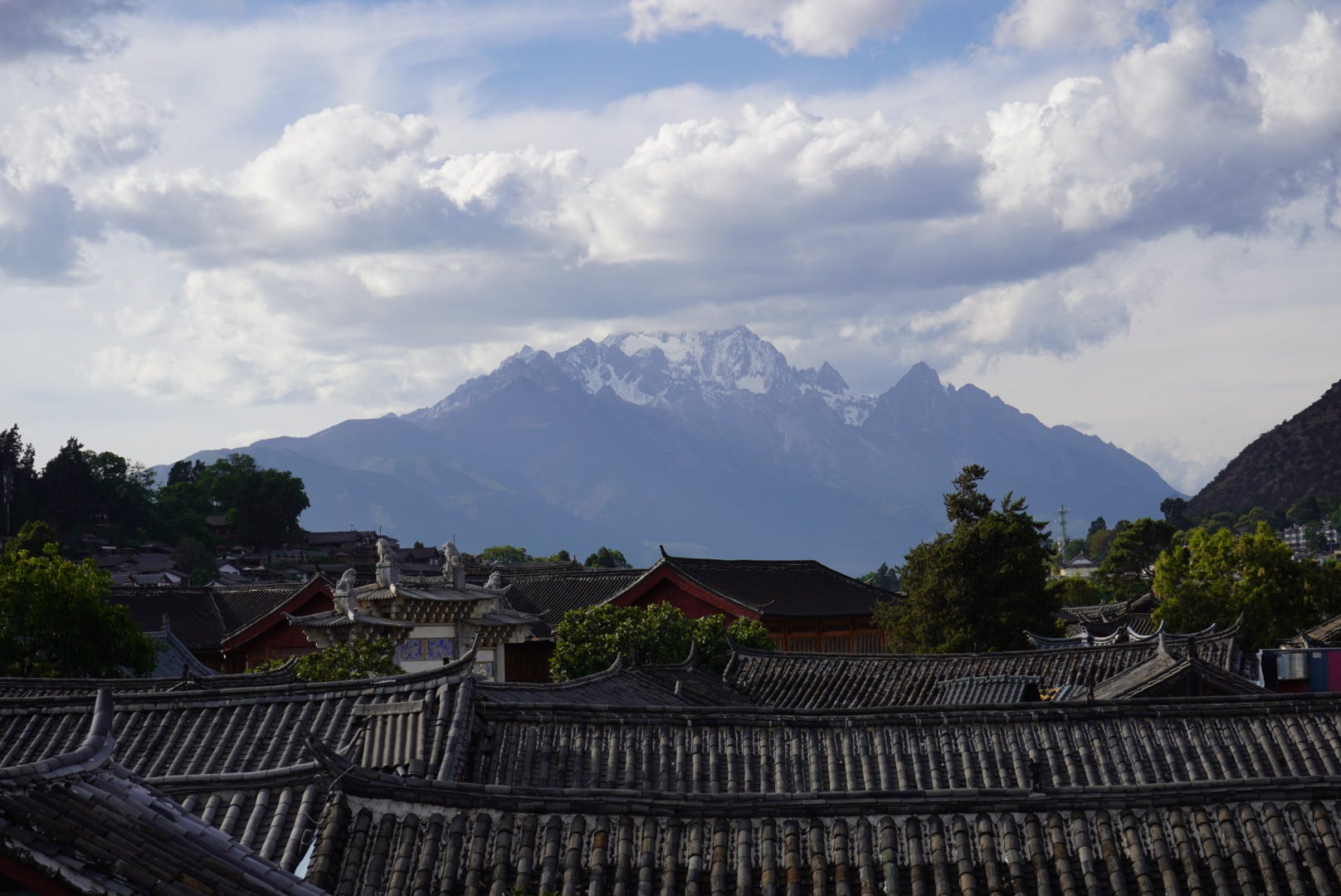
Fig 12. View back towards the mountain from the city of Lijiang
May 18th 2024
What does it mean to cycle
I’m left frequently to consider how little experience I actually have as a cyclist. Occasionally doubt would creep into my mind. Who am I to think that I can cross these mountains? That I can ride so far? That I can do it alone? I would do my best to remind myself that I wasn’t a cyclist anyway but a photographer without a driving license. I was here to observe, to tell stories, to hear stories, to make new ones and the bicycle was just a way of making that all happen.
When I got the first flat tire on my second day it was the first flat I had ever had to change alone. I was in a village outside of Leshan on the way to Ebian. The rain had started, as it did for each of the first 6 days of the trip, and so I pulled into a driveway where an old man sat on his porch weaving a basket from strips of bamboo. We never spoke but I did my work and he did his.
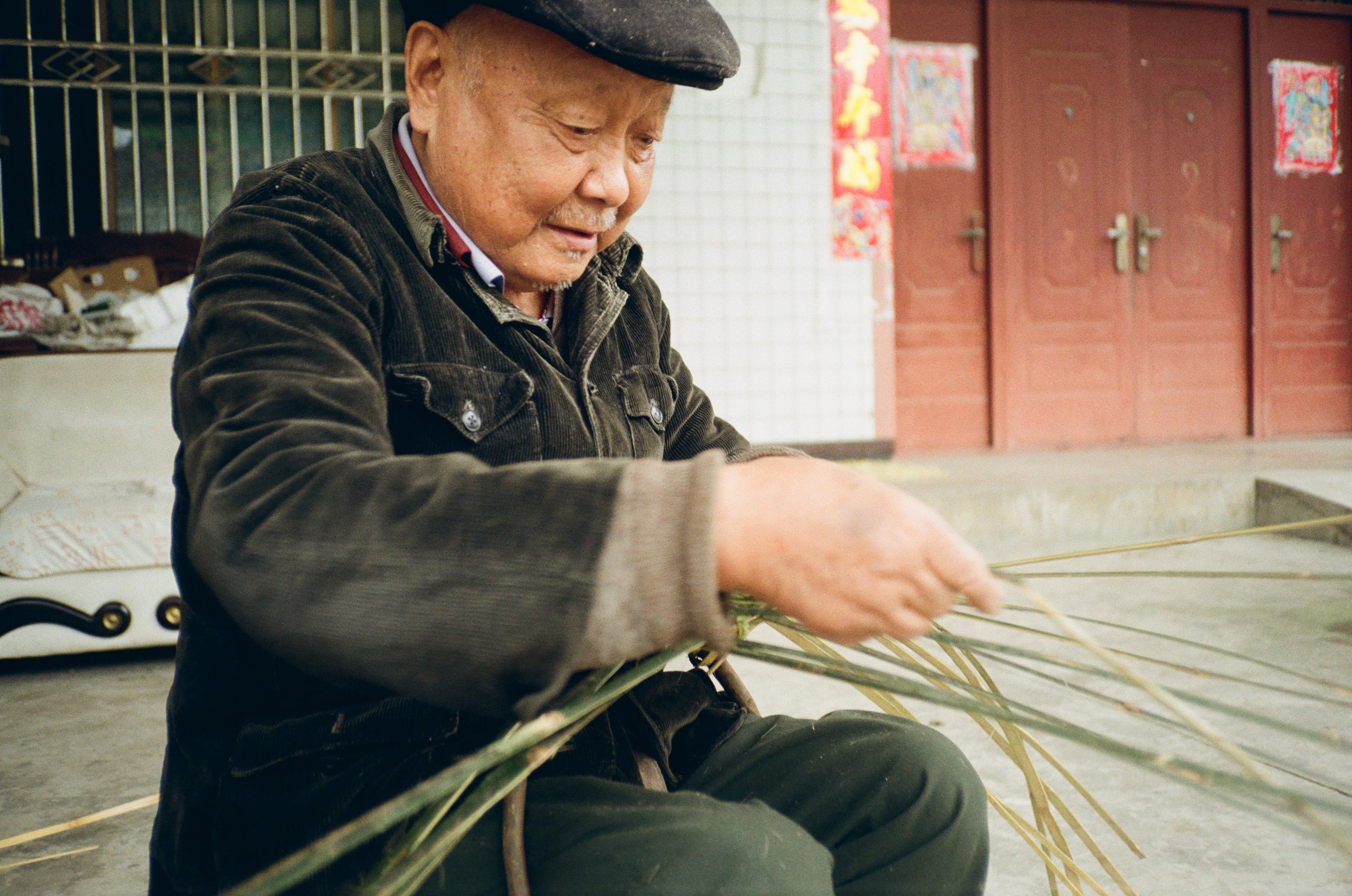
Fig 13. Man weaving baskets from strips of bamboo
I realised in this village that there was no cavalry, no one would be coming to save me and that truly the journey couldn’t continue until the tyre was fixed. That realisation brought about a level of clarity and singular focus that I find all too rare. Our lives are full of distractions, things that feel important but in the end probably aren’t. The thing I love most about riding bicycles is that sensation, that sense of identifying a singular task and stopping at nothing until its done. Fix the tyre, ride the bike, do it again tomorrow. There is a certain sense of confidence that comes from that, the realisation that with two wheels and time, you could see any corner of the world you choose.
Ride more bikes, smile at strangers, take more photos.
With Love,
Kenza
This owns. Please keep writing these! Regarding cross cultural communicators - there are fewer and fewer, and it really surprises me. I first went to China in 99 and have mostly been there since, and I expected that speaking Chinese would become less useful over time as more people learned it. And then they didn’t! Numbers of decent mandarin speakers plunged in a way I found very surprising.
So delighted I stumbled into your Substack today. If I do nothing else but keep reading your back catalogue today I'd be happy! So many delightful turns of phrases, great photographs of people just being people, and then i got to THAT photo, of the majestic Jade Dragon Snow Mountain. Incredible. Im a big fan already!